"International Training Course on Disaster Prevention and Reduction Knowledge Services and Digital China-Pakistan Economic Corridor" was successfully held in Pakistan
From May 20 to 21, 2026, the International Training Course on Disaster Prevention and Reduction Knowledge Services and the Digital China-Pakistan Economic Corridor was successfully held at the National Disaster Management Authority (NDMA) of Pakistan. This training focuses on building disaster prevention and reduction capabilities in the China-Pakistan Economic Corridor, empowers disaster prevention and control with digital technology, and builds an international platform for academic exchanges, technology sharing, and talent co-education in the field of disaster management between China and Pakistan, achieving complete results.
This training was organized and taught by the UNESCO International Engineering Science and Technology Knowledge Center (IKCEST) Disaster Prevention and Reduction Knowledge Service System Team. The training activity was hosted by the China-Pakistan Joint Research Center for Earth Sciences (CPJRC), co-organized by the Institute of Geographical Sciences and Resources, Chinese Academy of Sciences and the South China Sea Institute of Oceanography, Chinese Academy of Sciences, and the UNESCO International Engineering Science and Technology Knowledge Center Disaster Prevention and Reduction Knowledge Service System, Pakistan's National Disaster Management Administration, National Earth System Science Data Center, World Data System China Group-China Geographical Society and other units jointly organized.
The training was conducted through a combination of online and offline methods, attracting 30 professional students from the Pakistan Disaster Management Bureau to participate offline, providing professional and systematic learning opportunities for key personnel in the field of disaster management in Pakistan.
At the opening ceremony, Professor Hong Tianhua, Executive Director of the China-Pakistan Joint Research Center for Earth Sciences, and Wang Juanle, head of the IKCEST Disaster Prevention and Reduction Knowledge Service System and Researcher of the Institute of Geographical Sciences and Resources, China Academy of Sciences, delivered speeches, systematically reviewing the background of disaster prevention and reduction cooperation in the China-Pakistan Economic Corridor, and in-depth explanations of the core purpose and curriculum system of this training, laying a solid foundation for the smooth development of the training. The training closely follows the core of digital disaster reduction and technology empowerment, and sets up 4 high-level special reports, focusing on cutting-edge technologies and practical applications: Researcher Wang Juanle of the Institute of Geographical Sciences and Resources, China Academy of Sciences, gave a report on "Big Data-Driven Disaster Prevention and Reduction Knowledge Services" to share the application of big data in disaster prevention and reduction; senior engineer Bu Kunzheng explained the practical operation methods of practical geospatial technology around "Geospatial Processing Based on Python Open Source Tools"; Associate Researcher Yang Xiaodong focused on "Marine Geological Disasters along the East Markland Subduction Zone" to analyze the characteristics of regional structures and disasters and put forward key suggestions for prevention and control; Associate Researcher Zha Caicai shared the topic of "Using Open Source Code ASPECT to Simulate Plate Boundary Processes" and cutting-edge technologies for disaster mechanism simulation.
In the early stage of the training, team members participated in the second China-Pakistan Hydrogeological Disaster Early Warning Seminar held at the National Disaster Management Authority (NDMA) of Pakistan. Researcher Wang Juanle served as the chairman of the special branch of "Digital China-Pakistan Economic Corridor: Empowering Data-Driven Disaster Resilience" and delivered a branch report to further deepen practical cooperation between China and Pakistan in the fields of hydrogeological disaster warning and digital disaster reduction.
This training aims to systematically improve the disaster prevention and control capabilities of areas along the China-Pakistan Economic Corridor by strengthening disaster risk management, promoting digital disaster reduction technology, and deepening China-Pakistan cooperation and talent training, thereby achieving their sustainable development.
Researcher Wang Juanle gave a lecture report on the training class
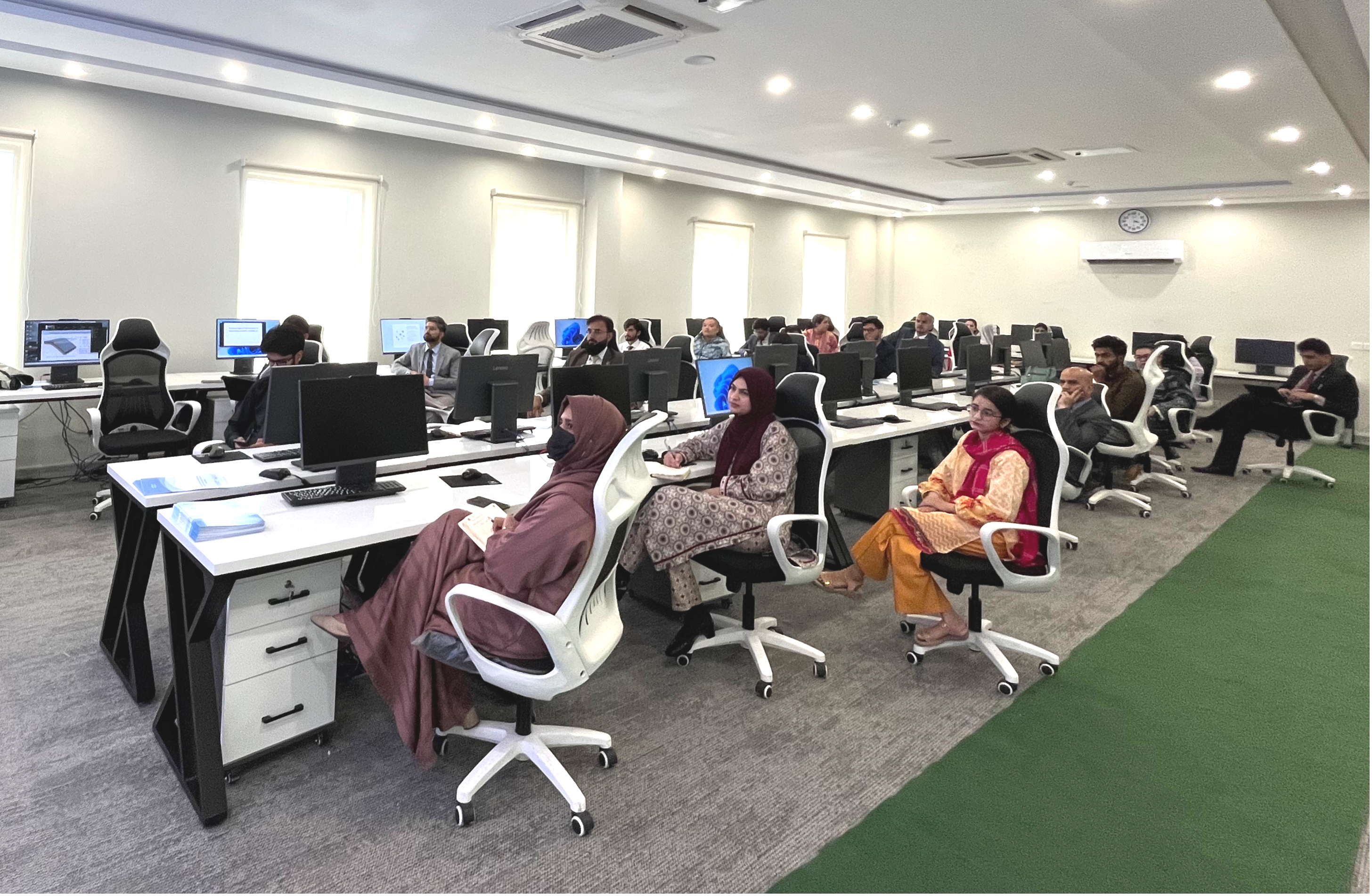
On-site NDMA training students focused on listening to reports
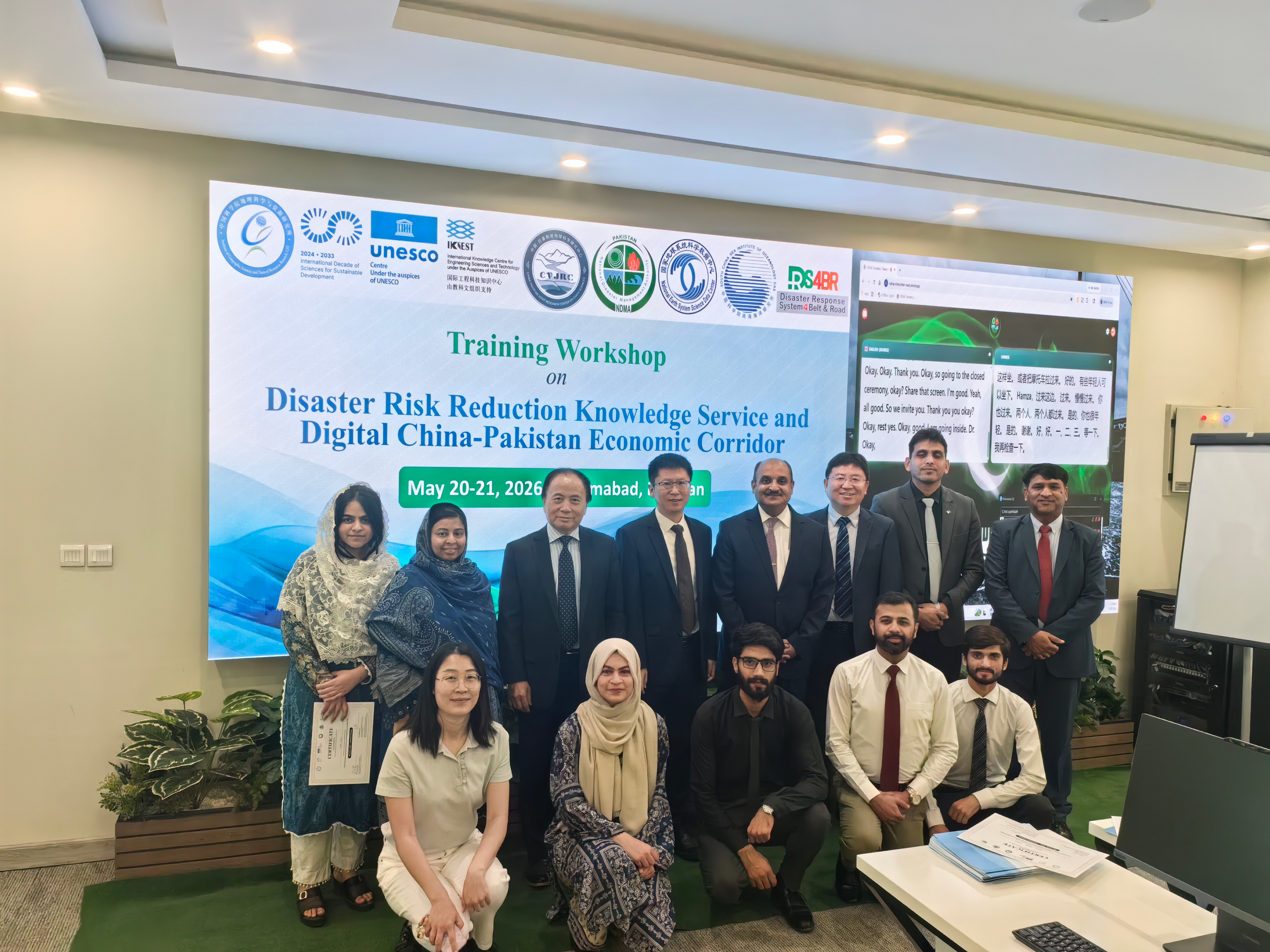
Group photo taken by some participants at the closing ceremony
Original Text (This is the original text for your reference.)
"International Training Course on Disaster Prevention and Reduction Knowledge Services and Digital China-Pakistan Economic Corridor" was successfully held in Pakistan
From May 20 to 21, 2026, the International Training Course on Disaster Prevention and Reduction Knowledge Services and the Digital China-Pakistan Economic Corridor was successfully held at the National Disaster Management Authority (NDMA) of Pakistan. This training focuses on building disaster prevention and reduction capabilities in the China-Pakistan Economic Corridor, empowers disaster prevention and control with digital technology, and builds an international platform for academic exchanges, technology sharing, and talent co-education in the field of disaster management between China and Pakistan, achieving complete results.
This training was organized and taught by the UNESCO International Engineering Science and Technology Knowledge Center (IKCEST) Disaster Prevention and Reduction Knowledge Service System Team. The training activity was hosted by the China-Pakistan Joint Research Center for Earth Sciences (CPJRC), co-organized by the Institute of Geographical Sciences and Resources, Chinese Academy of Sciences and the South China Sea Institute of Oceanography, Chinese Academy of Sciences, and the UNESCO International Engineering Science and Technology Knowledge Center Disaster Prevention and Reduction Knowledge Service System, Pakistan's National Disaster Management Administration, National Earth System Science Data Center, World Data System China Group-China Geographical Society and other units jointly organized.
The training was conducted through a combination of online and offline methods, attracting 30 professional students from the Pakistan Disaster Management Bureau to participate offline, providing professional and systematic learning opportunities for key personnel in the field of disaster management in Pakistan.
At the opening ceremony, Professor Hong Tianhua, Executive Director of the China-Pakistan Joint Research Center for Earth Sciences, and Wang Juanle, head of the IKCEST Disaster Prevention and Reduction Knowledge Service System and Researcher of the Institute of Geographical Sciences and Resources, China Academy of Sciences, delivered speeches, systematically reviewing the background of disaster prevention and reduction cooperation in the China-Pakistan Economic Corridor, and in-depth explanations of the core purpose and curriculum system of this training, laying a solid foundation for the smooth development of the training. The training closely follows the core of digital disaster reduction and technology empowerment, and sets up 4 high-level special reports, focusing on cutting-edge technologies and practical applications: Researcher Wang Juanle of the Institute of Geographical Sciences and Resources, China Academy of Sciences, gave a report on "Big Data-Driven Disaster Prevention and Reduction Knowledge Services" to share the application of big data in disaster prevention and reduction; senior engineer Bu Kunzheng explained the practical operation methods of practical geospatial technology around "Geospatial Processing Based on Python Open Source Tools"; Associate Researcher Yang Xiaodong focused on "Marine Geological Disasters along the East Markland Subduction Zone" to analyze the characteristics of regional structures and disasters and put forward key suggestions for prevention and control; Associate Researcher Zha Caicai shared the topic of "Using Open Source Code ASPECT to Simulate Plate Boundary Processes" and cutting-edge technologies for disaster mechanism simulation.
In the early stage of the training, team members participated in the second China-Pakistan Hydrogeological Disaster Early Warning Seminar held at the National Disaster Management Authority (NDMA) of Pakistan. Researcher Wang Juanle served as the chairman of the special branch of "Digital China-Pakistan Economic Corridor: Empowering Data-Driven Disaster Resilience" and delivered a branch report to further deepen practical cooperation between China and Pakistan in the fields of hydrogeological disaster warning and digital disaster reduction.
This training aims to systematically improve the disaster prevention and control capabilities of areas along the China-Pakistan Economic Corridor by strengthening disaster risk management, promoting digital disaster reduction technology, and deepening China-Pakistan cooperation and talent training, thereby achieving their sustainable development.
Researcher Wang Juanle gave a lecture report on the training class
On-site NDMA training students focused on listening to reports
Group photo taken by some participants at the closing ceremony




 User Center
 My Training Class
 Feedback






 Report
 Share
Share





Comments
Something to say?
Login or Sign up for free