

Welcome to the IKCEST
Gene therapy rescues hearing for the first time in aged mouse models
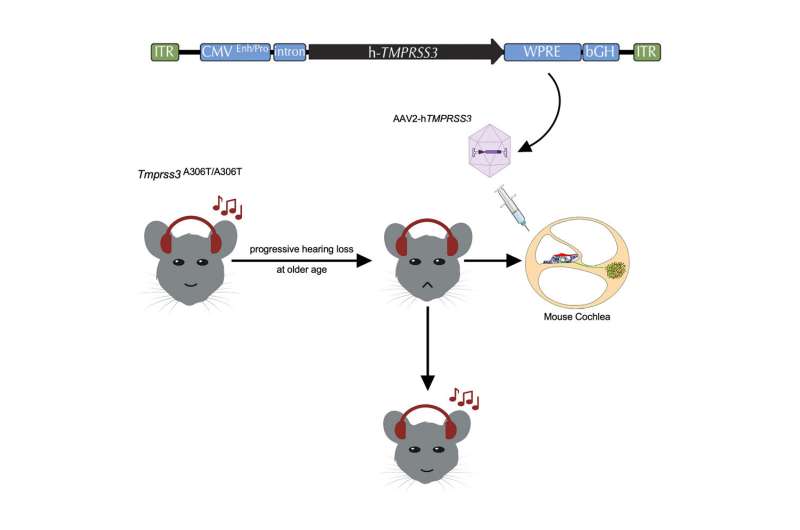
Graphical abstract. Credit: Molecular Therapy (2023). DOI: 10.1016/j.ymthe.2023.05.005

By 2050, one in 10 individuals are expected to live with some form of hearing loss. Of the hundreds of millions of cases of hearing loss affecting individuals worldwide, genetic hearing loss is often the most difficult to treat.

While hearing aids and offer limited relief, no available treatment can reverse or prevent this group of genetic conditions, prompting scientists to evaluate gene therapies for alternative solutions.

One of the most promising tools used in these therapies—adeno associated virus (AAV) vectors—has galvanized the hearing-loss community in recent years.

Despite having already rescued hearing in neonatal animals with , the vectors have yet to demonstrate this ability in fully mature or aged animal models. Since humans are born with fully developed ears, this proof-of-concept is necessary before testing the intervention in humans with genetic hearing loss.

A team of researchers from Mass Eye and Ear, a member of Mass General Brigham, recently became the first to successfully demonstrate AAV vector efficacy in aged animal models when they developed a mature mouse model with a mutation equivalent to a defective TMPRSS3 , which typically results in progressive hearing loss.

As reported in Molecular Therapy, researchers observed robust hearing rescue in the aged mice upon injecting the animals with an AAV carrying a healthy human TMPRSS3 gene.

"Our findings suggest that a virally mediated gene therapy, either by itself or in combination with a cochlear implant, could potentially treat genetic hearing loss," said corresponding author Zheng Yi Chen, D.Phil., an investigator in the Eaton-Peabody Laboratories at Mass Eye and Ear.

"This was also the first study that has rescued hearing in aging mice, which points to the feasibility of treating DFNB8 patients with DFNB8 even at an advanced age. The study also establishes the feasibility of other in the aged population."

Original Text (This is the original text for your reference.)

Gene therapy rescues hearing for the first time in aged mouse models
Graphical abstract. Credit: Molecular Therapy (2023). DOI: 10.1016/j.ymthe.2023.05.005

By 2050, one in 10 individuals are expected to live with some form of hearing loss. Of the hundreds of millions of cases of hearing loss affecting individuals worldwide, genetic hearing loss is often the most difficult to treat.

While hearing aids and offer limited relief, no available treatment can reverse or prevent this group of genetic conditions, prompting scientists to evaluate gene therapies for alternative solutions.

One of the most promising tools used in these therapies—adeno associated virus (AAV) vectors—has galvanized the hearing-loss community in recent years.

Despite having already rescued hearing in neonatal animals with , the vectors have yet to demonstrate this ability in fully mature or aged animal models. Since humans are born with fully developed ears, this proof-of-concept is necessary before testing the intervention in humans with genetic hearing loss.

A team of researchers from Mass Eye and Ear, a member of Mass General Brigham, recently became the first to successfully demonstrate AAV vector efficacy in aged animal models when they developed a mature mouse model with a mutation equivalent to a defective TMPRSS3 , which typically results in progressive hearing loss.

As reported in Molecular Therapy, researchers observed robust hearing rescue in the aged mice upon injecting the animals with an AAV carrying a healthy human TMPRSS3 gene.

"Our findings suggest that a virally mediated gene therapy, either by itself or in combination with a cochlear implant, could potentially treat genetic hearing loss," said corresponding author Zheng Yi Chen, D.Phil., an investigator in the Eaton-Peabody Laboratories at Mass Eye and Ear.

"This was also the first study that has rescued hearing in aging mice, which points to the feasibility of treating DFNB8 patients with DFNB8 even at an advanced age. The study also establishes the feasibility of other in the aged population."

Comments

    Something to say?

    Log in or Sign up for free

    Disclaimer: The translated content is provided by third-party translation service providers, and IKCEST shall not assume any responsibility for the accuracy and legality of the content.
    Translate engine
    Article's language
    English
    中文
    Pусск
    Français
    Español
    العربية
    Português
    Kikongo
    Dutch
    kiswahili
    هَوُسَ
    IsiZulu
    Action
    Related

    Report

    Select your report category*


    Reason*


    By pressing send, your feedback will be used to improve IKCEST. Your privacy will be protected.

    Submit
    Cancel